
Mars Distance from the Sun: A Comprehensive Guide
By Mia Phillips
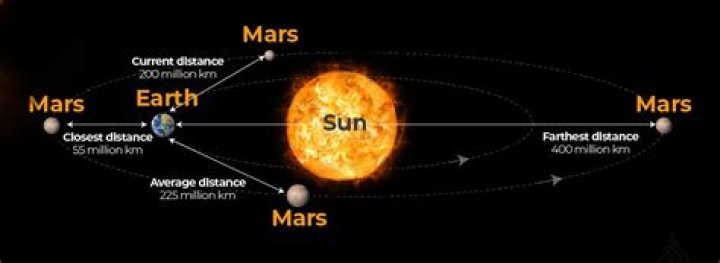
Understanding the distance between Mars and the Sun is essential for astronomers, space enthusiasts, and anyone interested in our solar system's dynamics. Mars, the fourth planet from the Sun, has a fascinating orbit that influences its distance from our star. In this article, we will delve into the details of Mars' journey around the Sun, exploring its average distance, closest and farthest points, and other related aspects.
Mars' distance from the Sun plays a crucial role in its climate, seasons, and potential for future exploration. By understanding the relationship between Mars and the Sun, we can better appreciate the complexities of our solar system and the challenges faced by space missions.
This article provides an in-depth analysis of Mars' distance from the Sun, covering key topics such as orbital mechanics, variations in distance, and the implications for planetary science. Let's dive in and explore the red planet's cosmic dance around our star.
Overview of Mars' Orbit
Understanding Mars' Elliptical Path
Mars follows an elliptical orbit around the Sun, meaning its distance from the Sun varies throughout its journey. This elliptical path is a result of gravitational forces acting on the planet. Unlike a perfect circle, an ellipse has two focal points, with the Sun located at one of these points for Mars' orbit.
The elliptical nature of Mars' orbit causes variations in its speed as it travels around the Sun. According to Kepler's laws of planetary motion, Mars moves faster when it is closer to the Sun and slower when it is farther away. This phenomenon is known as the "equal area in equal time" principle.
Key Features of Mars' Orbit
- Elliptical shape
- Varies in distance from the Sun
- Follows Kepler's laws of planetary motion
Average Distance of Mars from the Sun
The average distance of Mars from the Sun is approximately 227.9 million kilometers (141.6 million miles). This figure represents the mean distance over the course of Mars' orbit and provides a useful reference point for understanding its position in the solar system.
Scientists use astronomical units (AU) to measure distances within the solar system. One AU is the average distance between Earth and the Sun, approximately 149.6 million kilometers (93 million miles). In terms of AU, Mars is about 1.52 AU away from the Sun on average.
Perihelion and Aphelion of Mars
Mars' orbit brings it closer and farther from the Sun at different points. These points are known as perihelion and aphelion:
Perihelion
At perihelion, Mars is at its closest point to the Sun, which occurs approximately every 687 Earth days. During this time, Mars is about 206.6 million kilometers (128.4 million miles) away from the Sun.
Aphelion
At aphelion, Mars is at its farthest point from the Sun. This happens about half a Martian year after perihelion. During aphelion, Mars is approximately 249.2 million kilometers (154.8 million miles) away from the Sun.
Orbital Period of Mars
Mars takes about 687 Earth days to complete one orbit around the Sun. This is equivalent to approximately 1.88 Earth years. The longer orbital period of Mars compared to Earth is due to its greater distance from the Sun and the slower speed at which it travels in its orbit.
The orbital period of Mars is significant for planning space missions, as it determines the timing of launch windows and the duration of travel between Earth and Mars.
Seasonal Effects Due to Mars' Orbit
The elliptical orbit of Mars causes significant seasonal variations on the planet. When Mars is closer to the Sun at perihelion, it moves faster in its orbit, resulting in shorter seasons in the southern hemisphere. Conversely, when Mars is farther from the Sun at aphelion, it moves slower, leading to longer seasons in the northern hemisphere.
These seasonal variations influence the climate and weather patterns on Mars, including dust storms and changes in the polar ice caps.
Comparison with Earth's Orbit
Comparing Mars' orbit with Earth's orbit highlights the differences in their distances from the Sun and orbital characteristics:
- Earth's average distance from the Sun: 149.6 million kilometers (1 AU)
- Mars' average distance from the Sun: 227.9 million kilometers (1.52 AU)
- Earth's orbital period: 365.25 days
- Mars' orbital period: 687 Earth days
The greater distance of Mars from the Sun results in a longer year and more pronounced seasonal effects compared to Earth.
Impact on Space Missions
The distance of Mars from the Sun is a critical factor in planning space missions to the planet. Mission planners must consider the relative positions of Earth and Mars, as well as the timing of launch windows, to ensure successful journeys.
Launch windows for Mars missions occur approximately every 26 months when Earth and Mars are aligned on the same side of the Sun. This alignment minimizes the travel distance and fuel requirements for spacecraft traveling between the two planets.
Historical Significance of Mars' Distance
Throughout history, scientists and astronomers have studied Mars' distance from the Sun to gain insights into the solar system's structure and dynamics. Early observations of Mars' motion led to the development of Kepler's laws of planetary motion, which revolutionized our understanding of celestial mechanics.
Modern advancements in space exploration have allowed us to gather more precise data about Mars' orbit and its distance from the Sun. This information continues to inform scientific research and technological innovations in the field of astronomy.
Future Exploration and Mars' Distance
As humanity looks to the future of space exploration, Mars remains a key target for scientific investigation and potential colonization. Understanding Mars' distance from the Sun is essential for planning missions, developing technologies, and ensuring the safety of astronauts.
Future missions to Mars may involve longer stays on the planet, requiring careful consideration of the seasonal effects caused by its elliptical orbit. Advances in propulsion systems and life support technologies will be crucial for overcoming the challenges posed by Mars' distance from the Sun.
Conclusion
In conclusion, Mars' distance from the Sun is a fundamental aspect of its orbit and has far-reaching implications for planetary science and space exploration. From its average distance of 227.9 million kilometers to its perihelion and aphelion points, Mars' journey around the Sun is a fascinating subject of study.
By understanding the complexities of Mars' orbit, we can better appreciate the challenges and opportunities presented by this neighboring planet. We invite you to share your thoughts and questions in the comments section below and explore other articles on our site to deepen your knowledge of the solar system.
Data sources for this article include NASA's planetary data and scientific publications from reputable journals. For further reading, consider exploring resources from the Jet Propulsion Laboratory and the European Space Agency.


