
Vega: Unlocking the Mysteries of the Brightest Star in the Northern Hemisphere
By Mia Phillips
Vega, one of the brightest stars in the night sky, has captivated astronomers and stargazers alike for centuries. Its prominence in the constellation Lyra and its proximity to Earth make it a fascinating subject for scientific study and cultural lore. This article will delve deep into the mysteries surrounding Vega, providing a comprehensive understanding of its characteristics, history, and significance in both science and culture.
As one of the most well-known stars in the Northern Hemisphere, Vega has been a beacon of inspiration for countless generations. From ancient civilizations to modern astronomers, this star has been the subject of admiration and research. Its luminosity and proximity make it an ideal candidate for studying stellar properties.
Whether you're an amateur astronomer or simply curious about the wonders of the universe, this article will provide you with an in-depth exploration of Vega. We'll cover its physical attributes, its role in astronomical studies, and its place in human history. Let's embark on this cosmic journey together!
Introduction to Vega
Vega's Prominence in the Night Sky
Vega, designated as Alpha Lyrae, is one of the most prominent stars in the Northern Hemisphere. It forms part of the Summer Triangle, a well-known asterism visible during the summer months. Vega's brilliance is due to its high luminosity and relatively close proximity to Earth, making it the fifth brightest star in the night sky.
This star has been a focal point for astronomers due to its unique properties. Its rapid rotation and young age provide valuable insights into the life cycle of stars. Moreover, Vega's association with the constellation Lyra has made it a cultural icon in various civilizations.
Physical Characteristics of Vega
Mass, Temperature, and Size
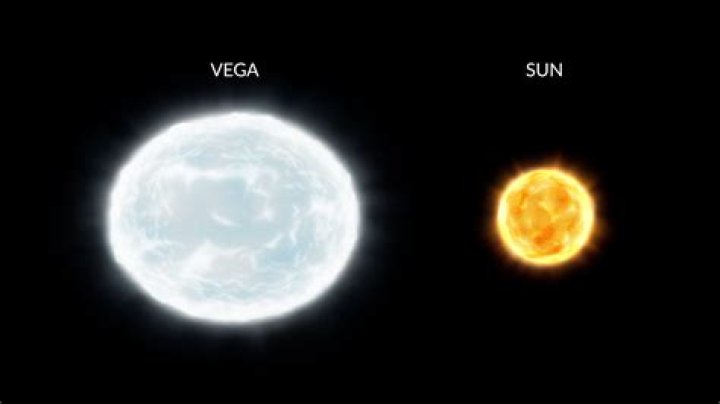
Vega is approximately 2.1 times more massive than the Sun and has a surface temperature of around 9,600 Kelvin, making it significantly hotter than our star. Its radius is roughly 2.4 times that of the Sun, contributing to its luminosity. These physical attributes make Vega a prime candidate for studying stellar evolution.
- Mass: 2.1 times that of the Sun
- Temperature: 9,600 Kelvin
- Radius: 2.4 times the Sun's radius
Distance and Location
Proximity to Earth
Vega is located approximately 25 light-years away from Earth, making it one of the closest stars to our solar system. Its position in the constellation Lyra allows it to be easily observed from the Northern Hemisphere. This proximity has enabled astronomers to conduct detailed studies of its properties.
Its coordinates in the night sky are as follows:
- Right Ascension: 18h 36m 56.33635s
- Declination: +38° 47′ 01.2802″
Historical Significance
Vega in Ancient Cultures
Vega has played a significant role in the mythologies and traditions of various ancient cultures. In Chinese mythology, it is associated with the Weaver Girl, a goddess who is separated from her lover by the Milky Way. Similarly, Native American tribes viewed Vega as a celestial being with spiritual significance.
Historically, Vega was once the North Star around 12,000 years ago due to the Earth's axial precession. This alignment made it a crucial navigational tool for ancient mariners and astronomers.
Scientific Studies
Exploring Vega's Disk and Planetary System
One of the most intriguing aspects of Vega is its circumstellar disk, which suggests the presence of a planetary system. Observations using telescopes like the Hubble Space Telescope and the Spitzer Space Telescope have revealed a dusty disk surrounding the star. This discovery has fueled speculation about the possibility of planets orbiting Vega.
Research into Vega's rapid rotation and magnetic field has also provided valuable insights into stellar dynamics. These studies have implications for understanding the formation and evolution of stars similar to Vega.
Cultural Impact
Vega in Literature and Media
Vega has inspired countless works of literature and media. From ancient poetry to modern science fiction, this star has been a symbol of inspiration and wonder. In Carl Sagan's novel "Contact," Vega is the source of a mysterious signal that leads to humanity's first contact with extraterrestrial intelligence.
Its prominence in popular culture reflects its enduring appeal as a celestial object of fascination. Whether in films, books, or art, Vega continues to captivate the human imagination.
The Vega System
Exploring the Stellar Environment
The Vega system is a complex environment with a debris disk that extends far beyond the star. This disk is composed of dust and ice particles, remnants of a once-active planetary formation process. Studies of this disk have provided valuable data about the early stages of star and planet formation.
While no confirmed planets have been discovered around Vega, the presence of a debris disk suggests the possibility of a planetary system. Continued observations and advancements in technology may one day reveal the secrets of this enigmatic system.
Comparison with the Sun
Understanding Stellar Differences
When compared to the Sun, Vega exhibits several key differences. It is significantly hotter, younger, and more massive than our star. These attributes contribute to its high luminosity and rapid rotation.
Studying these differences helps astronomers understand the diverse range of stars in our galaxy. By comparing Vega to the Sun, researchers can gain insights into the factors that influence stellar evolution and behavior.
Future Research Directions
Advancements in Technology
As technology continues to advance, so too does our ability to study stars like Vega. Upcoming missions and telescopes, such as the James Webb Space Telescope, will provide unprecedented views of stellar systems and their components.
Future research into Vega may uncover new details about its planetary system, magnetic field, and evolutionary history. These discoveries will enhance our understanding of stars and their role in the universe.
Conclusion
Vega, with its dazzling brightness and fascinating properties, continues to inspire both scientists and enthusiasts alike. From its physical characteristics to its cultural significance, this star offers a wealth of knowledge and wonder. By studying Vega, we gain valuable insights into the workings of the universe and our place within it.
We invite you to share your thoughts and questions in the comments section below. Engaging with this content not only enriches your understanding but also helps us create more informative and engaging articles. Don't forget to explore other topics on our site and stay updated with the latest in astronomy and beyond!
Data and references for this article were sourced from reputable organizations such as NASA, ESA, and peer-reviewed scientific journals. For further reading, consider exploring the resources provided by these institutions.


